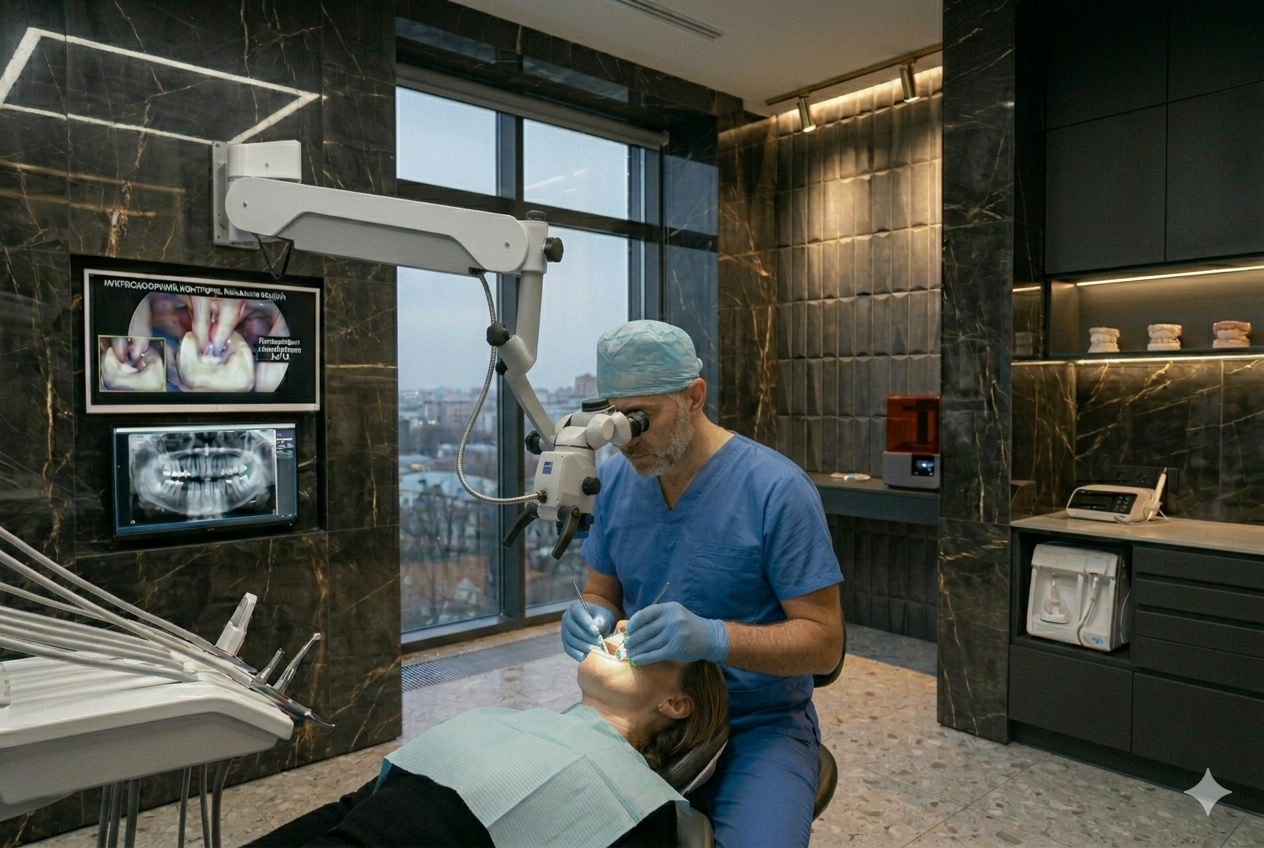
Apical Surgery: The Last Chance to Save Your Tooth
When conventional endodontic treatment (root canal therapy) does not yield the desired result or is impossible, apical surgery comes to the rescue. This is a microsurgical procedure that allows for the elimination of the source of infection without extracting the tooth itself.

What is Apical Surgery?
The most common procedure in this field is root-end resection (apicoectomy). Its essence lies in removing the very tip (apex) of the root along with the surrounding infected tissues (cyst or granuloma).
When is it Necessary?
- Complex anatomical conditions: When canals are severely curved or blocked by salt deposits (calcification).
- Presence of posts or crowns: If de-filling the canals could lead to a root fracture or damage to an expensive restoration.
- Persistent infection: When inflammation near the root does not disappear even after high-quality root canal treatment.
How is the Procedure Performed?
Thanks to modern equipment, the procedure is minimally invasive and painless:
- Anesthesia: Local numbing completely eliminates discomfort.
- Access: The surgeon makes a small incision in the gum to gain access to the bone.
- Resection: The root tip is removed (usually about 3 mm).
- Retrograde filling: This is a critically important stage. Using special material (most often MTA-based), the canal is sealed “from below,” from the root side, so that bacteria have no chance of escaping into the tissues.
- Suturing: The gum is neatly stitched.
Advantages of the Method
- Preservation of your own tooth: No implant can replace a natural root in terms of sensation and biomechanics.
- Speed: The operation usually lasts from 30 to 60 minutes.
- High success rate: When using an operating microscope, the effectiveness of the method exceeds 90%.
Important: Minor swelling is possible after the operation, which usually subsides within 2–3 days. Complete restoration of the bone tissue in the surgical area takes from several months to a year.
Conclusion
Apical surgery is not a “scary operation,” but a high-tech way to save a tooth that previously would have had to be extracted. The use of a microscope and modern bioceramic materials makes this process predictable and safe.
Have you heard of this method of tooth preservation before, or are you considering it as an alternative to extraction?