Latest Standards in Dental Fillings: Modern Methods and Technologies
The field of dentistry is developing extremely fast. What was considered a standard ten years ago is now giving way to minimally invasive and high-tech solutions. Modern filling is no longer just “closing a hole” in a tooth, but a full-fledged artistic and functional restoration.
1. Priority of Biocompatibility: Refusing Amalgam
Today, the global dental community has almost completely abandoned silver amalgam. Modern standards are based on the use of materials that have high biocompatibility and the ability to adhere (bond) to tooth tissues.
- Photopolymer Composites: This is the “gold standard.” They allow the doctor to work with the material for as long as needed to recreate the anatomy of the tooth, as they harden only under the influence of a special lamp.
- Ormocers: A new generation of materials based on organically modified ceramics. They have minimal shrinkage and contain no free monomers, making them ideal for allergy sufferers.
2. Microscopic Precision
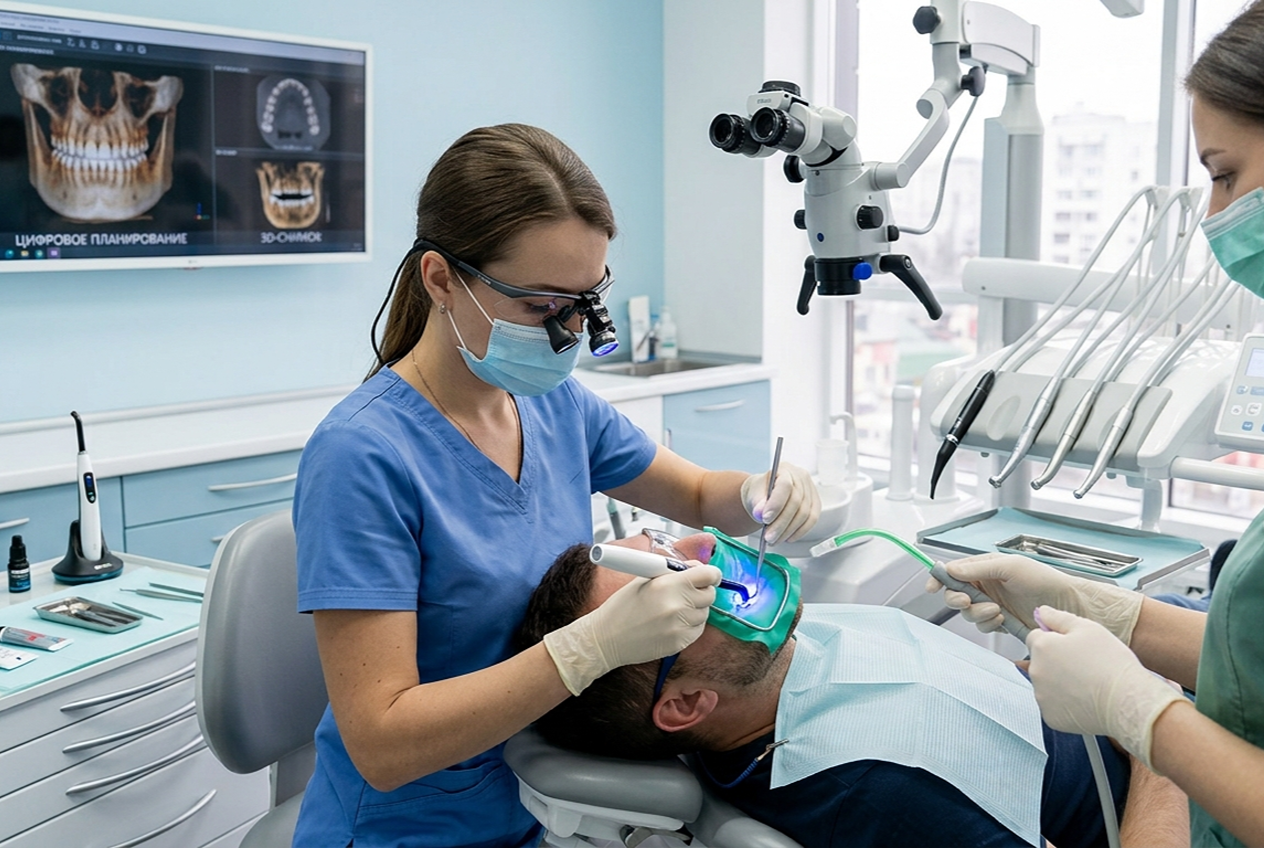
The use of a dental microscope has become a mandatory requirement for high-quality filling.
- Minimal Invasiveness: The microscope allows the doctor to see the boundary between healthy tissue and caries, removing only the damaged areas. This preserves the strength of the tooth.
- Hermeticity: Under high magnification, the dentist can perfectly adapt the material to the edges of the cavity, which eliminates the appearance of micro-cracks and secondary caries.
3. 3D Printing and CAD/CAM Technology
If tooth destruction is significant (over 50%), standard filling is replaced by ceramic inlays made using digital technologies.
- Intraoral Scanning: Instead of unpleasant impressions, a digital scanner is used.
- Modeling: A computer program creates an ideal model of the future restoration.
- Milling: A robotic machine mills the inlay from a solid block of zirconium dioxide or pressed ceramic. Such a “filling” lasts 3-4 times longer than a regular one.
4. Adhesive Protocols and Isolation
Modern filling is impossible without a rubber dam (latex sheet). It isolates the working field from the patient’s breath and saliva.
- Reliable Bonding: The latest generation of adhesives (dental glue) requires an absolutely dry surface. This is the only way to guarantee that the filling will not fall out in a year.
- Gum Protection: Materials do not contact the mucous membrane, which prevents chemical burns and inflammation.
The Future: Bioactive Materials
The latest trend is the development of “smart” fillings that release fluoride, calcium, and phosphates over a long period. This promotes remineralization of the tooth around the filling, literally strengthening it from the inside and preventing recurring destruction.
Today, a visit to the dentist is about comfort, aesthetics, and durability. Thanks to new standards, a properly installed restoration is visually indistinguishable from natural enamel and can last for decades.