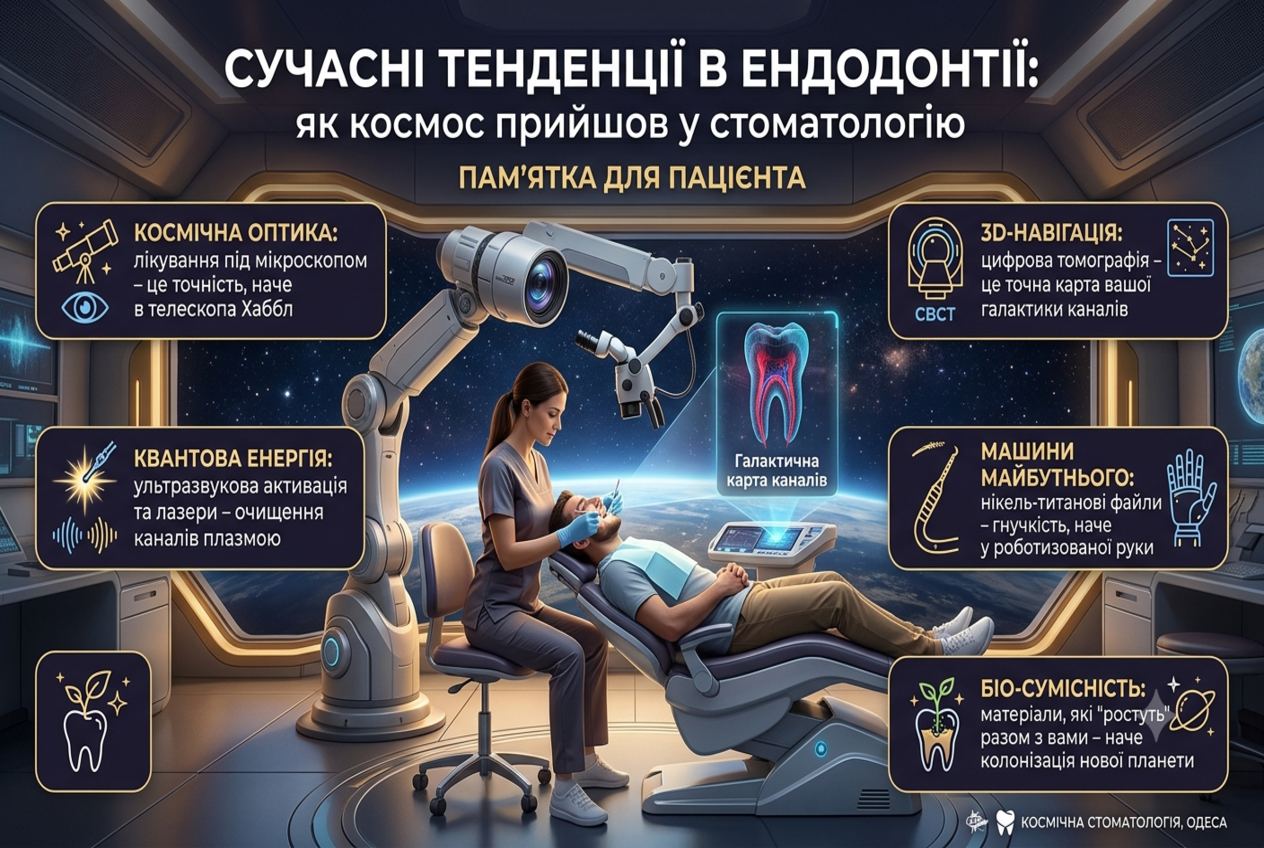
Modern Trends in Endodontics: How Space Age Technology Came to Dentistry. A Patient’s Guide
The phrase “you need a root canal” used to sound like a death sentence, often associated with multiple circles of hell, arsenic, and excruciating pain. Fortunately, those times are long in the past. Today, endodontics (the art of treating the inside of a tooth—the pulp and root canals) resembles a high-tech space mission. Thanks to new technologies, even teeth that were previously considered hopeless are now successfully saved.
Key Trends in Modern Endodontics: What Makes Treatment Effective?
A modern endodontist no longer works “blindly.” Their arsenal has changed beyond recognition:
- Treatment under a microscope: The golden rule of modern dentistry is: “You cannot treat what you cannot see.” A dental microscope magnifies the working field by 20–30 times and provides powerful lighting, which allows the doctor to find hidden canals, safely remove fragments of old instruments, and perfectly close perforations.
- “Smart” and flexible instruments (Nickel-Titanium files): Modern instruments are made from a special nickel-titanium (NiTi) alloy with shape memory. They are incredibly flexible, follow the most complex anatomical curves of the canal, and are controlled by a special endomotor that monitors rotation torque itself to prevent the instrument from breaking.
- Ultrasonic and laser irrigation: To flush out canals, antiseptics are used, which are activated by ultrasound or lasers. The liquid literally “boils” and blasts infection out of the smallest nooks, ensuring 3D cleaning.
- Three-dimensional obturation (Hot gutta-percha): The standard today is filling the canal with heated gutta-percha under pressure. It fills absolutely all anatomical voids and micro-canals, leaving no room for bacteria to survive.
- Bioceramics: To treat inflammation, bioceramic sealers are now applied. These are smart materials that the body does not perceive as foreign; they have an antibacterial effect and stimulate the restoration of the patient’s own bone tissue.
Patient’s Guide: The Essentials
To ensure your root canal treatment goes perfectly and your tooth lasts for many more years, remember a few simple rules.
When should you run to an endodontist?
- Spontaneous pain: the tooth begins to ache strongly or throb on its own, especially at night.
- Pain when biting: it feels as if the tooth has “grown” and it is painful to put pressure on it.
- Prolonged reaction to hot: if the tooth starts to hurt from a hot drink and the pain does not subside for several minutes (a classic sign of pulpitis).
- The appearance of a “pimple” on the gums (fistula) or swelling of the cheek.
How should proper treatment be conducted?
- Only with anesthesia: Modern root canal treatment is a completely painless procedure.
- Use of a rubber dam: A special rubber sheet isolates the tooth being treated from the rest of the mouth. It protects your airways from irrigation solutions and the tooth canal from bacteria in your own saliva. Today, root canal treatment without a rubber dam is considered a serious violation of protocol.
What to do AFTER root canal treatment?
- Normal reaction: The tooth may hurt when biting for 2–5 days after treatment. This is the so-called “post-filling syndrome” (a reaction of the tissues around the root to the intervention). Take the pain reliever recommended by your doctor.
- Mandatory restoration: A “dead” tooth becomes brittle. Therefore, the standard for an endodontically treated tooth is covering it with a crown or a ceramic overlay; otherwise, the tooth wall may break off.